
Carbondale Court Docket Searches
Start at the official Carbondale Municipal Court page. It names the clerk and judge. It also gives the session schedule and lists forms with payment details. You will not find a party-name search there, nor a downloadable docket history. So come prepared. Bring the citation, ticket number, case number, full name, and likely date. The clerk can work from those.
- Confirm that Carbondale Municipal Court is printed on the ticket.
- Locate the complete ticket or case number.
- Check the city’s published monthly date.
- Contact the municipal clerk for the setting, status, or copy route.
- Use Kansas Case Search only if the case is a state district matter.
If a payment vendor is down or a number is missing, call the city clerk directly. And if a state search turns up nothing for a city ordinance file, that is the expected result.
The Carbondale Clerk Prepares Dockets
Carbondale is more open than most small cities about what its clerk does. Ashley Madden serves as municipal court clerk, reachable at 785-836-8080 or citycourt@carbondaleks.com. The city says she manages court records, prepares dockets, collects fines, and issues subpoenas. She also fields questions about complaints, bench warrants, dispositions, and orders.
Chapter 9 of the municipal code backs that up. The code gives the clerk clear duties. They cover process, oaths, papers, docket preparation, trial settings, fines, and bonds. That language puts the record in the clerk's hands. For a Carbondale municipal record, contact her. Skip the statewide portal or a county administrative office.
Inside the Carbondale Municipal Court
Carbondale Municipal Court handles city ordinance cases. The city's page names Frederick Godderz as municipal judge. Tom Barnes II serves as city attorney. Assignments can change, so verify on the live page before relying on a name.
The court draws its power from city law and the Kansas municipal-court framework, including K.S.A. 12-4104. It is not part of the Osage County District Court. State felonies, state misdemeanors, and district traffic matters run through the district clerk instead. So do civil cases. The Kansas court system handles all of them.
Frederick and Eric Godderz Are Different Listings
Two judges share a surname. The Carbondale page lists Judge Frederick Godderz, while Fourth Judicial District materials list Judge Eric W. Godderz on Osage County district calendars. Same name, separate courts. Neither court's records merge with the other's.
Check the court name, not just the judge name. A Carbondale ordinance case stays with the city clerk, while an Osage district case follows the county portal, calendar, kiosk, and district clerk.
That distinction keeps a city hearing from being read as a state webdocket entry. The case number and the issuing authority tell you which record is which.
Finding Carbondale Court Dates
Carbondale Municipal Court convenes on the second Tuesday of each month at 4:00 p.m. Sessions are held at City Hall, 234 Main Street, Carbondale, Kansas 66414. The city has also published a full list of 2026 dates. That list beats the general monthly rule for precision. For any later year, check the live city page.
| Date pattern | Second Tuesday of each month, subject to the published annual list. |
|---|---|
| Time | 4:00 p.m. |
| Location | City Hall, 234 Main Street. |
| Judge | Frederick Godderz on the researched city page. |
| Setting type | Ask the clerk whether it is arraignment, review, plea, or another event. |
One monthly date is not a docket history. Confirm your own setting before you appear.
Carbondale Publishes Twelve 2026 Dates
The city page gives all twelve 2026 settings. Here they are: January 13, February 10, March 10, April 14, May 12, June 9, July 14, August 11, September 15, October 13, November 10, and December 8. September shows why the annual list matters. That date falls on the third Tuesday, not the usual second one.
Treat the list as a snapshot. It is not a fixed calendar. A holiday, a court order, or a city update can move a date. Confirm the current setting through the city page and the clerk. And do not assume every pending case sits on every listed date.
Carbondale Traffic Ticket Lookups
A ticket written under a Carbondale ordinance belongs to Carbondale Municipal Court. Give the clerk the case or ticket number. The city's payment instructions require that reference number for online, phone, or counter payment. Kansas state traffic cases take a different route. Use Kansas Case Search and the Osage District Court clerk.
Paying and contesting are not the same thing. A driver who wants payment arrangements or a reduced fine must appear at a hearing under the published instructions. There they can talk with the clerk or city attorney. The city does not promise that much. Its payment portal is not guaranteed to schedule a hearing or show the full record. For the wider court split, see the county traffic court page.
Carbondale Payment Does Not Replace Records
The city takes payment online, in person at City Hall, or by phone through its linked vendor. The transaction screen shows no docket result. A receipt proves you paid. It will not give you the complaint, the docket entries, the disposition order, or the next hearing date.
| Need | Correct Carbondale route |
|---|---|
| Pay known case | Online, phone, or City Hall with the ticket or case number. |
| Find missing number | Contact the municipal court clerk. |
| Get disposition or order | Request the court record from the clerk. |
| Discuss arrangement | Follow the city instruction to appear and speak with court staff. |
The clerk can separate a payment question from a record request.
Carbondale Arraignment and Plea Terms
Carbondale's court information describes arraignment as the first appearance, where guilty, not guilty, and no-contest pleas are entered. An arraignment date is not a conviction or any final result. It simply marks the point where the charge and the plea process get addressed.
- Guilty
- A plea admitting the charged violation.
- Not guilty
- A plea contesting the charge and leading to further process.
- No contest
- A plea that does not contest the charge, with legal effect determined by the court.
- Disposition
- The recorded outcome, which should be verified from the docket or order.
Ask the clerk for the event or filed order when the current status matters.
Carbondale Diversion Records Have Their Own Path
Carbondale's official court page offers two key documents. One is the Diversion Policies and Guidelines, plus an Application for Diversion. The city describes diversion as commonly lasting six to twelve months. Finish the terms and a case may be dismissed, subject to the program. That word matters. Applying, or even being enrolled, does not by itself mean the case ends.
Check any diversion question against the written agreement. Check the clerk's docket too, and any order actually filed. The city attorney or clerk can explain the published process, though eligibility and outcome never follow from a blank search or a payment receipt.
Carbondale Expungement Files Require the Clerk
The city publishes a Petition for Expungement. It comes with a local explanation of how it works. The petition gets forwarded to the prosecutor. If the prosecutor objects, a hearing may follow; with no objection, the judge can review the matter without one. Filers must bring valid state identification to the Municipal Court Office.
None of these steps guarantee eligibility or an order. For an existing expungement file, ask the clerk what is public and what is restricted. An expunged record may sit outside ordinary public access. A missing result should never be pieced together from other sources.
Carbondale Court Page Shows Local Functions
The official municipal page gathers the judge, clerk, court dates, forms, diversion, expungement, and record duties into a single city source.
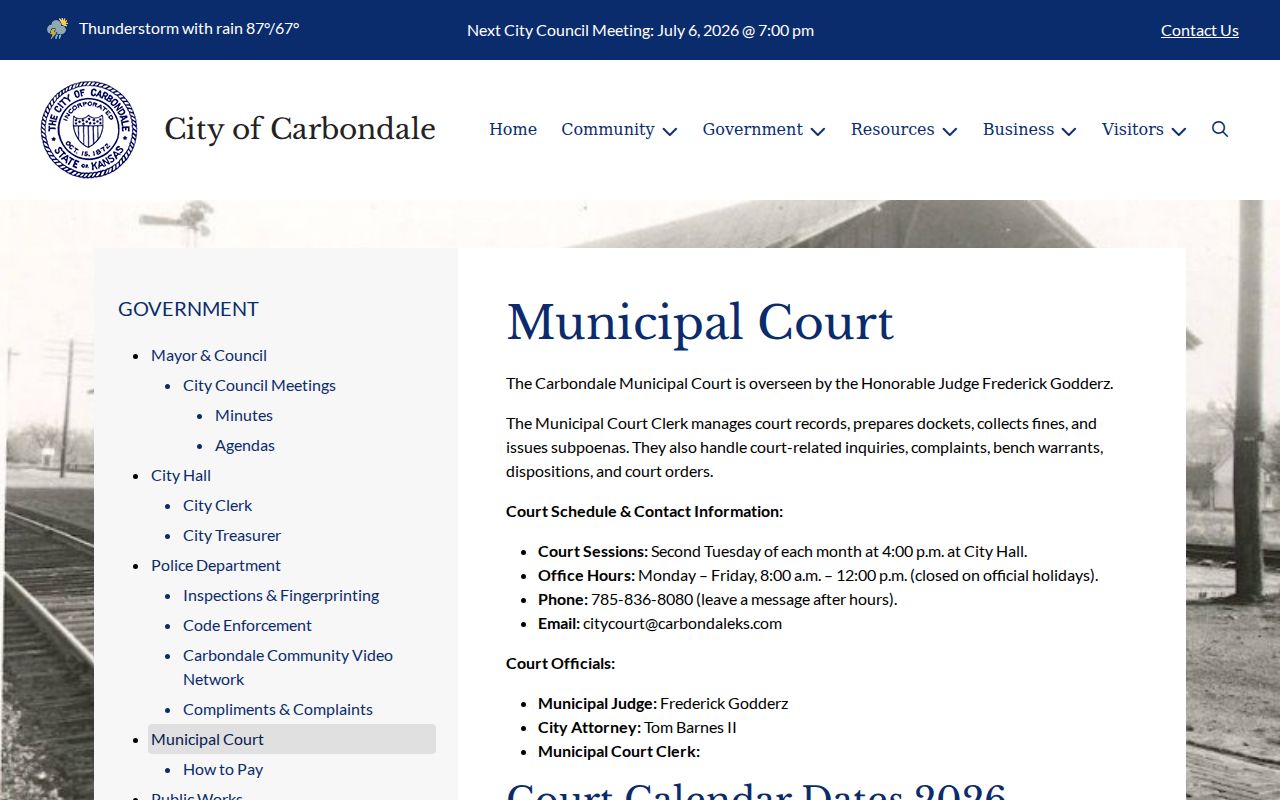
That page supports a clerk-first route to Carbondale court records. It also shows why the city source beats a general county search for a municipal case.
How Carbondale Cases Reach the County
Carbondale ordinance prosecutions stay in municipal court. A state charge or civil case arising in Carbondale can belong instead to the Osage County District Court. Which route applies depends on the type of law charged and the court printed on the papers.
Docket flow: Carbondale Municipal Court › Osage County District Court › Kansas appellate courts
This describes court levels, not an automatic transfer of every city case. For a district case, use the Osage County court docket route. Kansas Case Search never replaces the Carbondale clerk for an ordinance file.
Carbondale Is the Second Profiled City
The 2020 Census place table lists 1,352 Carbondale residents, second among the five Osage County cities profiled on these pages. Population says nothing about municipal caseload, and the city publishes no current case-volume report. What the record does show is real court operations: a published annual schedule, direct clerk contact, clear docket duties, multiple payment channels, and local diversion and expungement materials. That is genuine access, without invented filing numbers.
Who Can See Carbondale Court Records
Ask the municipal clerk for a specific complaint, docket entry, disposition, order, or setting. Municipal records remain governed by Kansas law, court orders, expungement rules, and privacy restrictions. The Kansas Open Records Act backs access to public records while honoring lawful exemptions and redaction.
Record access: K.S.A. 45-221 addresses exempt material and separation of open from closed portions when feasible. A payment or collections policy is not the court file.
The city publishes no certified-copy fee. Ask the clerk about cost, certification, delivery, and timing before relying on a copy for an official purpose.